


Table of Contents
Three Stories of Imagined Opinions
The Two Essential Questions
Evidence vs. Whispers
Step 1: Decide Whose Opinion Matters
Step 2: Decide Through Evidence
Now It’s Your Turn: Decision Matrix Tool
What if the voices steering your most significant life decisions aren’t even real?
Take the accomplished executive who had built a thriving business, held a director role, and was respected as a leader, wife, and mother. By every measure, she was already successful. And yet, she felt pulled to pursue a PhD, not because she needed it, but because of a dream her late father once had for her. Prestige, status, validation. Ghosts of expectations past.
Or the person desperate to pivot their life but paralyzed by the whispers of strangers. No evidence, no proof, just an imagined jury that she believed was judging their every move.
Or the mother who had fought for her place in a new country, built a career from scratch, and was thriving — but found herself haunted by what her eight-year-old daughter might think of her twenty years from now if she continued to pursue her career ambitions.
Three people, three different stories. The same problem: letting phantom opinions whispers, ghosts, and imagined judgments steer the wheel.
And in each of these scenarios, I asked a two-part question:
The first question is:
How do you know?
What evidence can you hold in your hands, place your gaze upon with your eyes, or hear with your ears that makes this fear or concern valid?
And every time I ask this question, without a single exception, the answer is always the same:
I don’t know. I have no evidence. It’s just in my head.
The second question is:
What evidence do you have?
What are you hearing? seeing, and sensing? What is the evidence around you telling you?
And again, without fail, when we looked closer, there was evidence. But the evidence always told a very different story.
For the woman holding on to her late father’s expectations, she knows that she is qualified without a PhD. How does she know? Well, she has built a successful business and is a sought-after expert. A PhD is not needed to be successful in her business and or be accomplished. She is already accomplished. That’s tangible evidence.
For the woman afraid of strangers’ judgment, all she’s ever received from those around her is encouragement. Positive reinforcement, positive feedback, promotions and more responsibility. That’s evidence. So, why hand power to a phantom jury that doesn’t even exist?
For the mother worried about her daughter’s future opinion, her daughter adores her right now. That’s evidence. Why would her daughter’s lover he lessen in the future based on her career choices?
The pattern is clear: The fears are almost always hypothetical- they live in our heads without evidence.
Which brings us to the fundamental question you should be regularly asking yourself:
How do you know?
How do you know whose opinion to listen to? Whose opinion matters? When the voice in your head should be explored or ignored?
Life is confusing- there is no manual for life’s big decisions, and there is often this sense of complete isolation that can make our fears bigger than they are.
Today, I would like to leave you with a framework that I use in my own decision-making and with clients, which will help you in moments of doubt.
It has two parts:
Decide Whose Opinion Matters
Adopt an Evidence-Based Approach
Step 1: “Decide Who”
The first step to dismantle unsupported ideas and opinions is to ask yourself whose opinion in my life really matters and to what degree it matters.
For me, the list is short:
The voice of God, my faith.
My own inner knowing.
My life partner.
The people who love me.
A small personal board of directors I’ve chosen with intention.
Everyone else?
Well, they are whispers in the wind. I couldn’t give a squirrel’s fart what they think.

Instead of worrying about what the phantom voices in my head say, I have developed a “Who Matters” board—comprised of people whom I love and trust.
How do you build this Who Matters Board? Well, it’s relatively easy. You write down the names of people who matter in your life and you ask yourself the following questions:
Does this person want the best for me?
Will this person’s opinion matter in the future as much as it does now?
Does my decision impact this person?
Is this person someone I respect and value?
Is this person someone I can learn and grow from?
You know who should never be on the Who Matters Board?
Strangers
Random people
Phantom people who only live in our heads
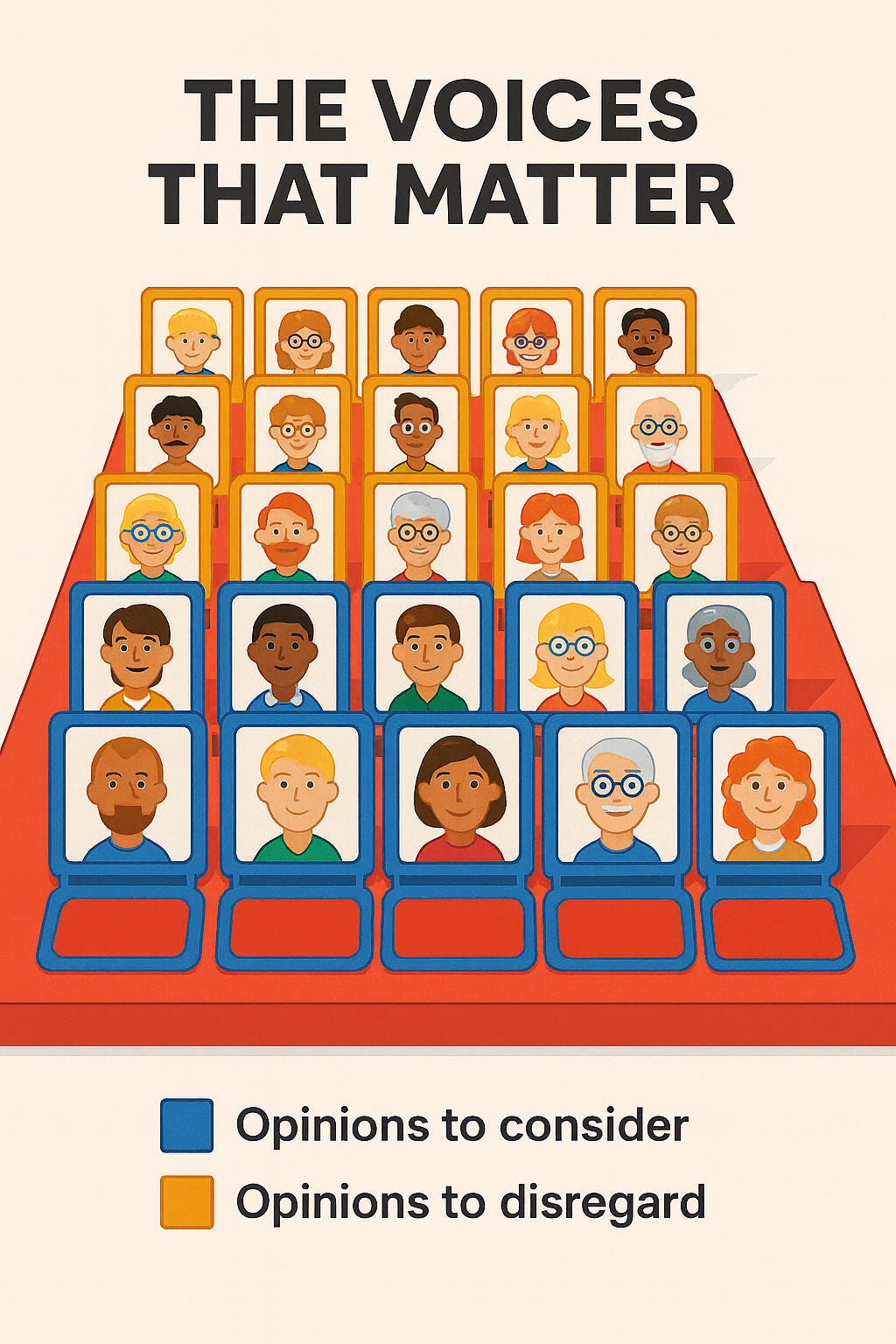
So whose opinion is that your life matters and in what order? Write it down, figure it out, because when someone gives you an opinion who is not on that list, it should very easily and quickly go in the “ignore” pile.
And yes, I mean, hands in fingers “la-la-la-la-la” mode.

And this is not to say that the opinions of strangers can’t be valuable. My local barista made an excellent recommendation for a latte that I would not have tried otherwise, but I didn't consult with him on an important life decision (see the difference).
Sometimes a random opinion from a stranger can spark an idea or perspective that challenges your thinking (hello Substack)- but you have to know that by default, it is just that, an input - not something that automatically warrants any weight, consideration or exploration unless you decide it is worthy.
So here’s the invitation: stop handing the steering wheel to whispers, strangers, bosses whose opinion won't matter when you move on to another job, or even worse, people who don’t even exist.
Step 2: Decide Through Evidence
Okay, now that you have decided whose opinion matters, even those voices can be overwhelming- and need to be assessed against evidence. Let’s go back to our successful executive who was considering a PhD as an example. When exploring the different choices she was facing, we took an evidence-based approach:
What ROI is there across the domains of her life?
What does that decision mean for her, her family, and her business?
What does it give her?/ What does it cost her?/ How did she know?
When you challenge your current narrative with evidence, you can easily reframe it and make a decision that feels aligned with your personal truth.
Now It’s Your Turn
Is there a decision you’re wrestling with right now?
Are there voices in your head, opinions, judgments, expectations, making you second-guess yourself or feel more cautious than you need to be?
Take the time to decide whose decision matters and use a simple set of questions to assess the evidence behind their opinions and ideas about the choices that matter most in your life. You can follow the process below as a guide:
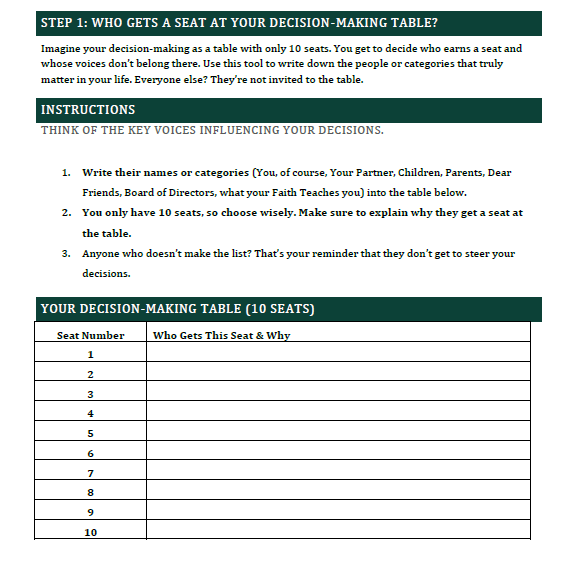
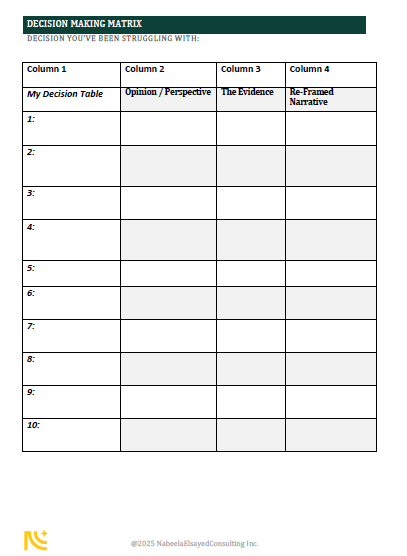
Here’s the truth: not every voice deserves a seat at your decision-making table. And the best way to get clear is to name exactly who does.
If you would like to download the complete Decision Matrix Tool guide to walk you through the process of building your very own Who’s on Your “Who Matters” Board. Inside, you’ll also find a blank Decision Matrix so you can apply an evidence-based approach to whatever choice is in front of you right now, along with step-by-step instructions and examples.
👉 [Download your Decision Matrix Tool here] for the price of a Salted Carmel Latte (my barista recommendation) $7.00 CAD, you will get an 8-page PDG guide you can print, fill out and re-use as often as you would like.
Because when you know whose voice really matters, the whispers lose their power.
Why Now Is A Great Time To Become a Pay Subscriber
I’m on a mission to share the very tools that have shaped my journey — the frameworks I relied on as an executive and now use every day in my coaching practice. Over the coming months, I’ll be releasing a library of practical, no-fluff resources designed to help you make clearer decisions, protect your energy, and re-imagine success on your terms.
Many of these tools will be free, and others I’ll be offering at a special discount exclusively for paid subscribers. If you’ve been thinking about upgrading, now is the perfect time — you’ll not only support this work, but you’ll also get first access to the tools I’ve seen transform leaders’ lives and careers.
Until Next Time. Take care of yourself and those around you.
In Partnership,
Nabeela


